
noorani qaida course for kids is an important starting point for children who are learning to read the Holy Quran correctly. Before reading Quranic verses independently, young learners need to recognize Arabic letters, understand their sounds, and practice combining them into words. A structured noorani qaida course for kids introduces these skills gradually, helping children build a strong foundation without feeling overwhelmed.
However, learning Arabic reading requires more than memorizing the alphabet. Children also need pronunciation practice, clear explanations, repetition, and encouragement. Therefore, choosing the right noorani qaida course for kids can make a meaningful difference in a child’s early Quran education.
With online learning, families can explore different ways to introduce Noorani Qaida lessons at home. Parents can also follow their children’s progress and help them maintain a consistent routine. In this guide, we explain what children learn, how lessons develop reading skills, and what families should consider when choosing a noorani qaida course for kids through El Furqan Academy.
How Does a Noorani Qaida Course Help Children Learn?
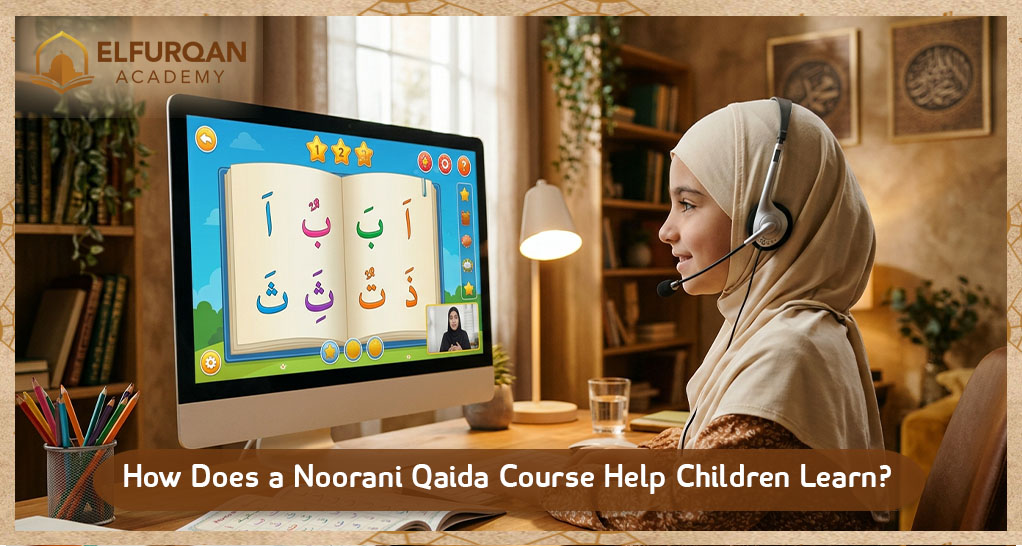
A noorani qaida course for kids is a beginner-level program that introduces children to the Arabic reading skills needed for Quran recitation. It usually follows a gradual sequence, starting with individual letters and moving towards connected sounds and simple words.
Instead of asking beginners to read complete Quranic passages immediately, this learning method breaks reading into manageable stages. As a result, children can focus on one skill before moving to the next. A typical noorani qaida course for kids introduces several essential topics:
- Arabic letters and their names.
- Different written forms of Arabic letters.
- Short vowel sounds and their symbols.
- Tanween and long vowels.
- Sukoon and Shaddah.
- Basic pronunciation and sound combinations.
- Early reading practice using connected Arabic letters.
Each stage builds on skills introduced earlier. For example, a child first learns to recognize a letter before practicing its sound with Fatha, Kasra, or Damma.
This gradual structure is particularly helpful for children who have never studied Arabic. Nevertheless, the progress of each learner depends on age, attention, previous experience, and regular practice. Therefore, a suitable noorani qaida course for kids should allow enough time for children to understand each topic.
Start Your Child’s Noorani Qaida Learning Journey
Give your child a strong foundation in Arabic reading through structured Noorani Qaida learning. Explore El Furqan Academy and discover the available learning options to help your child improve letter recognition, pronunciation, and Quran reading skills step by step.

Why Do Children Need a Strong Foundation Before Reading the Quran?
Children may recognize Arabic letters without knowing how to pronounce them accurately. Similarly, some learners can repeat familiar words but struggle when they encounter unfamiliar combinations.
A strong foundation helps address these difficulties before they become established reading habits. For this reason, a noorani qaida course for kids should focus on understanding basic reading skills rather than rushing children through lessons.
Recognizing Letters Before Reading Words
Arabic letters have individual sounds and written forms. Children need time to distinguish between letters that look or sound similar.
For instance, ب، ت، and ث share a similar basic shape, but their dots distinguish them. Therefore, learners should practice identifying each letter rather than relying only on visual memory.
A well-organized noorani qaida course for kids gives children opportunities to recognize letters in different orders. This is important because memorizing a familiar sequence does not always mean that a child can identify letters independently.
Developing Accurate Pronunciation
Correct pronunciation begins with learning how Arabic sounds are produced. Some letters require attention to their articulation points, which can be unfamiliar to children who speak another language.
A teacher can demonstrate the sound, listen to the child’s attempt, and provide corrections. Over time, this practice helps children become more aware of their pronunciation.
Pronunciation exercises should be an essential part of a noorani qaida course for kids because recognizing a written letter is different from producing its sound correctly.
Building Confidence Through Gradual Progress
Reading unfamiliar Arabic words can feel difficult when children are introduced to too many rules at once. However, breaking lessons into smaller steps makes the learning process more manageable.
For example, a child who recognizes letters and understands short vowels may feel more confident when beginning simple combinations. This confidence can encourage further practice.
A gradual Noorani Qaida course for kids allows children to strengthen their skills before moving to more difficult reading exercises.
What Do Children Learn in a Noorani Qaida Course for Kids?
A Noorani Qaida course for kids introduces several connected reading skills. Although the exact order may vary between teaching methods, the main learning areas usually follow a progression from basic recognition to early reading.
Understanding these stages helps parents recognize what their children are learning and why each topic matters.
1. Arabic Alphabet: Huroof Al-Mufradat
The first stage introduces the 28 Arabic letters individually. Children learn their names, written shapes, and basic pronunciation.
Teachers may use visual examples, repetition, and short activities to help younger learners remember each letter. Instead of memorizing the entire alphabet in one sitting, children can practice a few letters at a time. Important learning activities include:
- Identifying letters when shown individually.
- Repeating each letter after a teacher.
- Distinguishing between letters with similar shapes.
- Connecting each written letter with its correct sound.
- Reviewing previously learned letters regularly.
Parents can reinforce this stage by asking children to identify familiar letters during short practice sessions. However, the aim should be recognition and understanding, not speed.
The Noorani Qaida course for kids should also give learners opportunities to recognize letters outside their usual sequence. This helps parents and teachers assess whether children genuinely understand the alphabet.
2. Connected Letter Forms: Huroof Al-Murakkabat
Arabic letters can change their written appearance depending on their position within a word. Children therefore need to understand that one letter may look different when it appears at the beginning, middle, or end. This stage introduces the main forms of connected letters. For example, children may study:
- The isolated form of a letter.
- Its form at the beginning of a word.
- Its connected middle form.
- Its final form.
Not every Arabic letter connects to the following letter in the same way. Therefore, teachers should explain these differences through clear examples. Once children understand connected forms, they can begin recognizing how individual letters work together to create written words.
A noorani qaida course for kids should not move too quickly through this stage. Children need enough practice to recognize familiar letters even when their written appearance changes.
3. Short Vowels: Fatha, Kasra, and Damma
Short vowels are essential because they change how Arabic letters are pronounced. Children learn to recognize three basic vowel marks:
| Vowel mark | Arabic name | Basic sound |
|---|---|---|
| َ | Fatha | Short “a” sound |
| ِ | Kasra | Short “i” sound |
| ُ | Damma | Short “u” sound |
A child may recognize the letter ب independently, for example, but adding a vowel changes its pronunciation. The teacher can demonstrate each combination and ask the child to repeat it. Afterwards, the learner practices reading different letters with the same vowel mark.
This repeated comparison helps children understand that vowel symbols are not decorative marks. Instead, they provide important pronunciation information.
A noorani qaida course for kids should explain each vowel separately before combining the three marks in more challenging exercises. This approach can reduce confusion and help children recognize how small symbols affect pronunciation.
4. Tanween: Understanding Double Vowel Marks
Tanween introduces another important feature of Arabic pronunciation. It appears as a double vowel mark and generally produces an additional n-sound at the end of the relevant word or reading unit. Children usually encounter three forms:
- Fathatayn.
- Kasratayn.
- Dammatayn.
At first, these symbols may look confusing because they resemble the short vowel marks already studied. Therefore, teachers should explain the difference using simple examples and guided repetition.
Once learners can distinguish the symbols visually, they can practice reading them aloud. This helps prepare them for more advanced reading patterns.
In a noorani qaida course for kids, Tanween should be introduced after children have developed a reasonable understanding of the basic vowel marks. Otherwise, the additional symbols may make early reading more confusing.
5. Long Vowels: Huroof Al-Maddah
Long vowels teach children that some sounds are extended rather than pronounced briefly. The three letters commonly introduced in this stage are:
- Alif.
- Waw.
- Ya.
The teacher explains how these letters work with preceding vowel sounds to produce longer pronunciation. For instance, a short vowel and its corresponding long vowel should sound different when read correctly.
Children benefit from hearing both versions and repeating them. In addition, teachers can use simple comparisons to help learners recognize when a sound needs to be extended.
This stage is an important part of a noorani qaida course for kids because it introduces the difference between short and extended sounds. Regular listening and reading practice can help children become more familiar with these patterns.
6. Sukoon: Reading a Letter Without a Short Vowel
Sukoon is a small symbol placed above a letter to indicate that it does not carry a short vowel. Children need to understand how this affects the pronunciation of connected letters.
Rather than teaching Sukoon as an isolated symbol, a teacher should demonstrate how it works within a combination.
A beginner may initially pause too much or separate the sounds incorrectly. With guided practice, however, the child can learn to connect the sounds more naturally.
A noorani qaida course for kids should include short examples that allow children to hear and practice the difference between vowelled and unvowelled letters.
7. Shaddah: Recognizing Doubled Letters
Shaddah indicates that a letter is doubled in pronunciation. This concept requires careful explanation because children may initially read the marked letter as a single ordinary sound.
A useful approach is to compare a letter without Shaddah with the same letter carrying the symbol. The teacher can then demonstrate the difference through repetition.
Children should also practice Shaddah within short combinations before moving to more demanding reading exercises.
By introducing Sukoon and Shaddah gradually, a noorani qaida course for kids helps children understand important reading patterns before they encounter more complex Quranic words.
How Does a Noorani Qaida Course for Kids Develop Pronunciation?
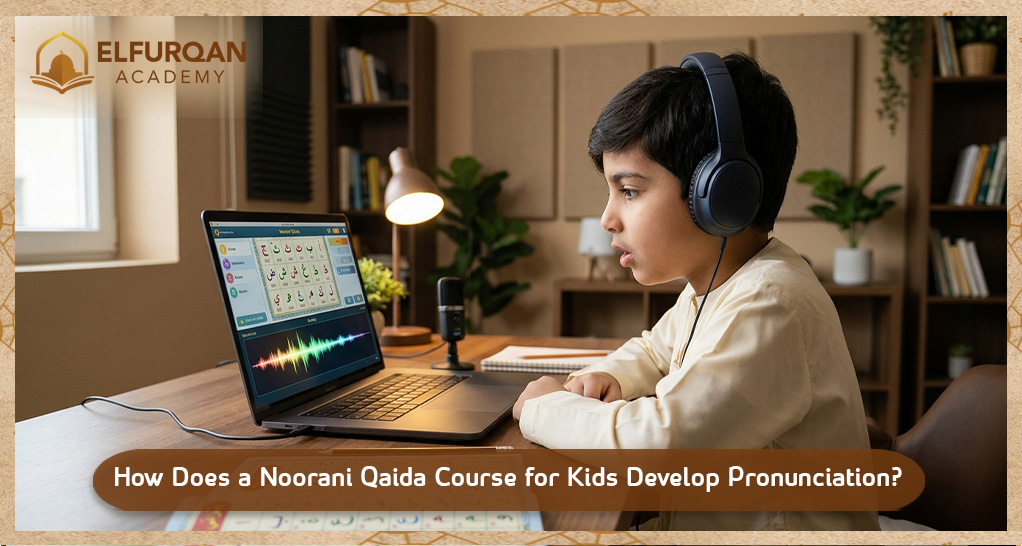
Recognizing Arabic letters is only one part of learning to read the Quran. Children also need to develop accurate pronunciation through listening, repetition, and correction.
A noorani qaida course for kids can support this development by introducing sounds gradually. However, the quality of feedback matters as much as the learning materials.
Understanding the Articulation Points of Arabic Letters
Arabic letters are produced from different parts of the mouth and throat. These articulation points are commonly known as Makharij Al-Huroof.
Some sounds may be unfamiliar to children, particularly those who do not speak Arabic at home. Therefore, simply asking them to repeat a letter without explanation may not be enough.
A teacher can demonstrate the sound and explain the mouth or tongue position using age-appropriate language. The child then repeats the sound while receiving feedback.
This process can help children understand that correct reading involves both recognizing letters and producing their sounds accurately.
Distinguishing Between Similar Arabic Sounds
Some Arabic letters can be difficult for beginners to distinguish. Children may confuse letters because their written shapes are similar or their sounds are unfamiliar. Regular comparison exercises can help them notice these differences. For example, a teacher may:
- Show two similar-looking letters.
- Explain the difference between their sounds.
- Pronounce each letter clearly.
- Ask the child to identify and repeat them.
- Review the distinction in later lessons.
Importantly, children should receive corrections in a supportive way. Repeated criticism may discourage them, whereas specific and encouraging feedback can help them improve.
A Noorani Qaida course for kids should therefore combine careful pronunciation guidance with a positive learning environment.
Basic Tajweed Foundations for Young Learners
Noorani Qaida introduces reading skills that support later Quran learning. It can also prepare children to understand some basic pronunciation principles associated with Tajweed. Parents who want to understand these principles in greater detail can explore Tajweed Rules Of The Quran.
Nevertheless, completing the beginner’s book does not automatically mean that a child has mastered all Tajweed rules. At this stage, the main priorities include:
- Recognizing Arabic letters correctly.
- Producing their sounds as accurately as possible.
- Understanding short and long vowels.
- Reading connected letters.
- Recognizing Sukoon and Shaddah.
- Developing a habit of listening carefully to correct recitation.
As children become more confident, teachers can gradually introduce additional Tajweed concepts according to their learning level.
This distinction is important because early reading skills and advanced recitation rules are related, but they are not identical. A child needs a secure foundation before progressing to more complex material.
A noorani qaida course for kids should establish basic reading accuracy rather than promise complete Tajweed mastery at the beginner stage.
One-to-One Noorani Qaida Lessons for Children
Individual instruction can be useful when a child needs focused pronunciation practice or a learning pace suited to their abilities. In a one-to-one lesson, the teacher can concentrate on the learner rather than dividing attention among several children. This may make it easier to notice repeated mistakes and explain difficult sounds.
How Can Individual Lessons Support Learning?
- Review letters the child finds difficult.
- Adjust the pace according to the learner’s progress.
- Listen carefully to pronunciation.
- Repeat an explanation when necessary.
- Give the child opportunities to ask questions.
- Spend additional time on difficult vowel combinations.
For example, one child may quickly recognize the Arabic alphabet but struggle with connected letters. Another may understand the written forms but need more pronunciation practice.
Both children can benefit from lessons that respond to their actual difficulties rather than following an inflexible pace. Parents considering a Noorani Qaida course for kids should ask how lessons are structured and whether the teaching approach allows enough time for individual practice.
Why Children Need Encouragement During Lessons?
Young learners may become frustrated when they repeatedly confuse letters or forget vowel marks. Therefore, encouragement should be part of the learning process. Teachers can divide activities into short sections and recognize genuine improvement. They can also use simple questions and interactive exercises to maintain attention.
However, encouragement should not replace accurate correction. Children need both a supportive environment and clear guidance to develop reliable reading skills.
The Role of Quran Teachers in Early Childhood Education
Teaching young children requires patience, clear communication, and an understanding of how beginners learn. A teacher may know the Arabic reading rules well, but explaining them to a young learner requires additional teaching skills.
A suitable teacher should be able to simplify difficult concepts without changing their meaning. Furthermore, the teacher should recognize when a child needs repetition rather than introducing another lesson.
Qualities Parents Should Look For
- Knowledge of Arabic pronunciation and Quran reading.
- Ability to explain concepts in child-friendly language.
- Patience when a learner makes repeated mistakes.
- Clear communication with parents.
- Willingness to review previous lessons.
- Ability to identify the child’s learning difficulties.
Parents should also ask how progress is assessed. A clear explanation of the learning stages helps families understand what their child is working towards. When evaluating a Noorani Qaida course for kids, parents should confirm the teacher’s relevant experience and qualifications directly. They should not assume that every online program follows identical teaching standards.
Requirements Before Starting Online Noorani Qaida Lessons
Online lessons can make Quran education more accessible, but children need a suitable learning environment. Preparing a few practical details before the first session can reduce interruptions.
A Stable Internet Connection
A reliable internet connection helps children hear the teacher clearly and participate without frequent interruptions.
Poor audio quality can make pronunciation lessons especially difficult. Therefore, parents should test the connection before the session whenever possible.
A Suitable Device
Children need a device with a working camera, microphone, and clear audio. A laptop or tablet may provide a more comfortable viewing experience than a small mobile screen.
The device should also be positioned safely and comfortably. Parents can adjust the screen height so that the child can see the teacher without straining.
A Quiet Learning Space
A quiet area helps children focus on the teacher’s voice and their own pronunciation.
Parents should try to reduce background noise, television sounds, and unnecessary interruptions. A consistent learning location may also help the child recognize when it is time to study.
Familiarity With the Online Platform
Before lessons begin, parents should check how the selected platform works. This may include joining a meeting, adjusting microphone settings, and using the camera.
If the child is unfamiliar with online meetings, a short practice session can make the first lesson less stressful.
Parent Support
Younger learners may need help opening the lesson, arranging their materials, or following instructions.
However, parents do not need to answer every question for the child. Instead, they can provide practical assistance while allowing the teacher to guide the learning process.
These preparations can make a Noorani Qaida course for kids easier to follow and help families avoid preventable technical problems.
How Can Parents Support Their Children’s Noorani Qaida Learning?
Parents play an important role in helping children maintain a regular learning routine. Even when a teacher leads the lesson, home support can reinforce what the child has learned. Parents can also explore the benefits of Reading Quran Daily to understand how regular Quran reading can become part of family life.
Establish a Realistic Practice Routine
Short, consistent practice sessions may be more manageable than occasional long study periods. Parents can agree on a routine that fits the child’s daily schedule. The exact duration should depend on the learner’s age, concentration, and the teacher’s recommendations. A simple routine might include:
- Reviewing previously learned letters.
- Practicing the current lesson.
- Listening to a correct pronunciation example.
- Repeating difficult combinations.
- Finishing with a brief review.
The purpose is to reinforce understanding rather than make the child feel pressured. Families can also use these tips to memorize quran online when supporting consistent Quran learning at home.
Avoid Comparing Children
Children develop reading skills at different speeds. One learner may remember letters quickly, while another needs more repetition to distinguish similar sounds. Comparing siblings or classmates can create unnecessary pressure. Instead, parents should pay attention to each child’s individual progress.
Communicate With the Teacher
Regular communication helps parents understand what their child has learned and which areas need further practice. For example, parents can ask whether the child is confusing particular letters or needs more work on vowel combinations. This information makes home practice more focused and prevents unnecessary repetition of material the child already understands.
Make Practice Positive and Age-Appropriate
Children are more likely to participate when learning activities feel manageable. Parents can use letter cards, simple identification games, and short listening exercises.
Nevertheless, activities should support the actual lesson rather than distract from it. The teacher’s guidance should remain the main reference for pronunciation and reading accuracy.
A consistent home routine can reinforce the skills introduced in a noorani qaida course for kids without turning practice into a stressful obligation. Parents who want to continue their own learning can also explore Learn To Read Quran For Adults and Learn Arabic For Quran.
Common Challenges Children Face When Learning Noorani Qaida
The following examples highlight common difficulties children may encounter while learning Arabic letters, vowel sounds, and basic reading skills. They also show how regular practice and appropriate guidance can help children gradually overcome these challenges.
Scenario One: A Child Who Confuses Similar Arabic Letters
Imagine a young learner who recognizes several Arabic letters but frequently confuses ب، ت، and ث.
At first, the child may identify the letters correctly when they appear in a familiar sequence but struggle when their order changes. This can happen because the learner remembers the general shape without paying enough attention to the dots.
A teacher may address the problem through short comparison exercises. First, the child identifies each letter separately. Next, the teacher changes their order and asks the learner to name them again.
Afterward, the child practices the sounds aloud. Repeating this activity across several lessons can help strengthen recognition. The important point is that the teacher should identify the reason behind the mistake instead of simply asking the child to repeat the entire alphabet.
Scenario Two: A Child Who Understands Letters but Struggles With Vowels
Consider another learner who can recognize the Arabic alphabet but finds it difficult to read letters with Fatha, Kasra, and Damma. The child may pronounce individual letters correctly but forget how the vowels change their sounds. Consequently, reading combinations becomes confusing.
A teacher can introduce one vowel at a time and use simple comparisons. Once the child understands the first pattern, the teacher can introduce another and review both together.
Parents can support this process by practicing only the combinations assigned by the teacher. This avoids overwhelming the child with too many examples at once.
These scenarios show why a noorani qaida course for kids should respond to each learner’s specific difficulties rather than assuming every child needs the same amount of practice.
Common Challenges Children Face When Learning Noorani Qaida
Although a structured method can make learning easier, children may still encounter difficulties. Recognizing these challenges helps parents and teachers respond appropriately.
Confusing Similar Letters
Letters with similar shapes may be difficult to distinguish, especially when children are first learning the Arabic alphabet. Helpful approach: Use visual comparisons, ask the child to identify letters in different orders, and revisit difficult examples regularly.
Forgetting Vowel Marks
Children may recognize letters but forget how Fatha, Kasra, and Damma affect pronunciation. Helpful approach: Practice a small number of combinations and compare the sounds carefully.
Losing Concentration During Online Lessons
Young learners may become distracted by their surroundings or find it difficult to remain seated throughout a session. Helpful approach: Keep the learning environment quiet, use age-appropriate lesson activities, and discuss suitable session arrangements with the teacher.
Feeling Shy About Reading Aloud
Some children hesitate because they are afraid of making mistakes in front of another person. Helpful approach: Encourage the child to try without pressure. A teacher should correct errors calmly and allow enough time for the learner to respond.
Progressing Too Quickly
Moving to new material before understanding earlier lessons can create gaps in reading skills. Helpful approach: Review previous topics and make sure the child can apply them before moving forward.
A good Noorani Qaida course for kids should recognize these challenges and give learners time to address them before introducing more difficult material.
How to Choose the Right Noorani Qaida Course for Kids?
Choosing a suitable course involves more than comparing prices or lesson schedules. Parents should consider whether the teaching approach matches the child’s needs and whether the learning stages are clearly explained.
A noorani qaida course for kids should provide a logical learning sequence, opportunities for pronunciation practice, and appropriate feedback.
Check the Learning Curriculum
Ask which topics the course covers and how lessons progress from basic letters to connected reading.A clear curriculum should explain how children learn:
- Individual Arabic letters.
- Connected letter forms.
- Short vowels.
- Tanween.
- Long vowels.
- Sukoon and Shaddah.
- Basic reading combinations.
Understand How Progress Is Reviewed
A course should provide a clear way to discuss the child’s development. Parents can ask how teachers identify pronunciation problems and whether previous lessons are reviewed.
Useful progress indicators include improved letter recognition, more accurate vowel sounds, and the ability to read familiar combinations with less assistance.
However, progress should be evaluated according to the child’s actual performance rather than a fixed promise about how quickly every learner will finish.
Ask About Teaching Methods
Children respond differently to visual examples, listening activities, repetition, and guided reading. Parents should find out how lessons are delivered and whether the teaching style is suitable for the child’s age and attention span.
It is also useful to ask how the teacher handles repeated mistakes. A supportive approach should combine patience with accurate correction.
Consider Communication and Scheduling
Parents need to understand how lesson arrangements work and whom they can contact when they have questions. Before enrolling, confirm the available schedule, lesson duration, attendance expectations, and any relevant technical requirements. These details help families decide whether they can maintain a consistent routine.
Learning With El Furqan Academy
Parents considering El Furqan Academy can begin by reviewing the information available about its Noorani Qaida teaching options and the way lessons are organized.
The most important step is to understand whether the course matches the child’s current reading level. A beginner who has never studied Arabic may need a different starting point from a child who already recognizes most letters.
Before enrolling, families should ask El Furqan Academy about the curriculum, teacher qualifications, lesson format, and how progress is communicated.
They can also discuss the child’s particular difficulties, such as confusing similar letters or struggling with vowel marks. This conversation may help parents understand whether the proposed learning approach is appropriate. When evaluating El Furqan Academy, parents should seek clear answers about the following points:
- Which Noorani Qaida topics are included?
- How does the teacher assess the child’s starting level?
- How are pronunciation mistakes corrected?
- What happens when a child needs additional revision?
- How can parents follow the learning process?
- What arrangements are available for lesson scheduling?
It is also important to confirm the details of any available teaching format rather than assuming that all courses provide the same arrangements.
For families exploring El Furqan Academy, a conversation about the child’s age, Arabic background, and learning goals can help establish realistic expectations.
Ultimately, the right choice should depend on the child’s needs and the clarity of the teaching process. El Furqan Academy should be evaluated using the same practical criteria parents would apply to any Quran education program.
How to Measure a Child’s Progress in Noorani Qaida?
Progress in a Noorani Qaida course for kids should be measured through the skills a child can demonstrate, not simply the number of completed lessons.
A learner may finish several pages but still confuse important letters. Another child may study fewer pages while developing stronger pronunciation and recognition. Therefore, parents should focus on practical signs of improvement when evaluating a noorani qaida course for kids.
Letter Recognition
Can the child identify familiar letters when they appear in a different order? Can the learner distinguish between letters with similar shapes?
These abilities show whether recognition is becoming more reliable. Regular assessment helps teachers identify which letters need additional attention during a noorani qaida course for kids.
Understanding Vowel Symbols
A child should gradually become more comfortable identifying Fatha, Kasra, and Damma and pronouncing the corresponding combinations.
Parents can ask the teacher which vowel patterns the child should review at home. This approach makes practice more focused and supports steady progress throughout a noorani qaida course for kids.
Reading Connected Letters
Another useful indicator is the ability to recognize connected forms without depending entirely on memorized examples. Children should gradually understand how letter shapes change according to their position within a word. Teachers can use unfamiliar combinations to check whether learners understand these patterns during a noorani qaida course for kids.
Responding to Corrections
A child may not pronounce every sound perfectly at first. However, noticing a correction and attempting to apply it during later practice can indicate developing awareness.
Parents should discuss these observations with the teacher instead of expecting immediate perfection. A well-monitored Noorani Qaida course for kids should consider how children respond to feedback and improve over time.
Helping Children Move From Noorani Qaida to Quran Reading
Completing the beginner’s lessons is an important milestone, but the transition to reading the Quran should be based on demonstrated ability.
Children need to recognize letters, understand basic vowel patterns, and read connected combinations with reasonable confidence before progressing. A noorani qaida course for kids should prepare learners for this transition rather than encourage them to advance simply because they have completed the pages.
Review the Main Reading Skills
- Individual Arabic letters.
- Connected letter forms.
- Short and long vowels.
- Tanween.
- Sukoon.
- Shaddah.
- Basic pronunciation.
If the child still struggles with an essential topic, additional practice may be necessary. Reviewing these areas helps confirm whether the learner has developed the foundation expected from a noorani qaida course for kids.
Begin With Suitable Quranic Reading Practice
The teacher can introduce short and manageable Quranic reading exercises according to the learner’s level. During this stage, pronunciation remains important. Children should not focus only on reading faster or completing more lines.
Instead, they should learn to read carefully and recognize when they need guidance. This gradual approach connects the skills learned in a Noorani Qaida course for kids with practical Quran reading.
Continue Learning Beyond the Beginner Stage
Noorani Qaida provides a foundation, but Quran education continues through regular recitation, correction, and further study. As the child develops, the teacher can introduce additional reading and Tajweed concepts at an appropriate pace. The lessons completed in a noorani qaida course for kids are therefore the beginning of a longer learning journey.
This gradual transition helps prevent the learner from moving forward without understanding the skills required for accurate recitation.
Frequently Asked Questions About Noorani Qaida Course for Kids
Find answers to common questions about a Noorani Qaida course for kids, including learning methods, practice routines, pronunciation, and children’s progress.
1. What should parents do if a child refuses to practice at home?
Parents should first try to understand why the child is reluctant. The difficulty may involve tiredness, frustration, distraction, or uncertainty about the lesson.
A short break and a smaller practice goal may help. If the problem continues, parents should discuss it with the teacher and agree on a realistic routine that supports the child’s progress in a Noorani Qaida course for kids.
2. Can a child learn Noorani Qaida if Arabic is not spoken at home?
Yes. Children do not need to speak Arabic fluently before beginning to learn its letters and reading patterns. However, they may need additional listening and pronunciation practice.
Regular exposure to correct sounds and clear teacher guidance can support their learning. A suitable noorani qaida course for kids should account for differences in children’s language backgrounds and learning needs.
3. How can parents tell whether a child is memorizing examples instead of understanding the rules?
Parents can ask the teacher to present familiar letters or vowel combinations in a different order. If the child can recognize and pronounce them in new examples, this may indicate stronger understanding.
If the learner succeeds only with memorized sequences, more practice with varied examples may be useful. This type of assessment can help parents understand the child’s actual progress in a noorani qaida course for kids.
4. Should children continue reviewing Noorani Qaida after starting Quran reading?
Reviewing earlier skills can remain useful even after a child begins reading Quranic passages.
If the learner encounters difficulties with a letter, vowel, or connected form, the teacher can revisit the relevant Qaida lesson. This helps strengthen foundational skills without requiring the child to restart the entire course.
Conclusion
A Noorani Qaida course for kids helps children develop the basic Arabic reading skills needed before progressing to Quran recitation. Through letter recognition, connected forms, vowel practice, and pronunciation guidance, young learners can build a foundation step by step.
However, successful learning requires more than completing lessons. Children need consistent practice, suitable teaching methods, encouragement, and time to understand each stage.
Parents should therefore evaluate the curriculum, teaching approach, communication, and progress assessment before choosing a course. When considering El Furqan Academy, they should confirm the available course details and discuss their child’s individual learning needs.
With realistic expectations and regular support, children can develop greater confidence in reading Arabic and prepare for the next stage of their Quran learning journey.