
The benefits of reading Quran daily are not always discovered through long hours of recitation. Sometimes, they begin with a single verse, a quiet morning, and a sincere desire to reconnect with Allah.
It was 6:15 on a rainy Monday morning in London.
Adam sat alone at his kitchen table, staring at the endless notifications lighting up his phone. Between work deadlines, family responsibilities, and the pressure of everyday life, he barely had a moment to think.
He was Muslim. He prayed. He fasted during Ramadan. He genuinely wanted to become closer to Allah.
But there was something he had been avoiding.
The Quran.
Not because he didn’t love it, but because reading Arabic felt incredibly difficult.
Every time he opened the Quran, unfamiliar letters reminded him how much he still had to learn.
What if I pronounce something incorrectly? What if I don’t understand what I’m reading? What if five minutes isn’t enough?
That morning, Adam made a different decision.
Instead of scrolling through his phone, he opened the Quran and slowly recited three short verses.
He struggled with the pronunciation.
He stopped more than once.
But he finished.
And for the first time in weeks, his morning began with something more meaningful than a notification.
Adam’s story is fictional, but his experience reflects a challenge many non-Arabic-speaking Muslims face.
If you’ve ever felt disconnected from the Quran because of language barriers or a busy schedule, his journey might feel familiar.
Let’s explore how a small daily habit can lead to meaningful spiritual growth.
Why the Benefits of Reading Quran Daily Go Beyond Recitation

For Muslims, the Quran is the word of Allah, revealed to Prophet Muhammad (peace be upon him) as guidance for humanity.
It teaches us about faith, patience, gratitude, forgiveness, and the purpose of our existence.
Yet building a connection with the Quran doesn’t require becoming an expert overnight.
It begins with consistency.
Allah says in the Quran:
“And We have certainly made the Qur’an easy for remembrance, so is there any who will remember?” (Surah Al-Qamar 54:17)
This verse reminds believers of the importance of approaching the Quran for remembrance and reflection.
Understanding the benefits of reading Quran daily can help you see recitation as more than another task on your schedule.
It’s an opportunity to pause, remember Allah, and reflect on how His guidance relates to your life.
For someone learning Arabic as a second language, even a few carefully recited verses can represent real progress.
And that progress deserves patience.
7 Benefits of Reading Quran Daily for Non-Arabic Speakers
Reading the Quran daily brings comfort, strengthens faith, and helps non-Arabic speakers find peace, purpose, and spiritual balance in everyday life.
1. Finding Peace in the Middle of a Busy Life
Two weeks after starting his routine, Adam noticed something unusual.
His responsibilities hadn’t changed.
He still had demanding workdays, long commutes, and difficult conversations.
But his mornings felt different.
Before opening his emails, he spent a few minutes reading the Quran and reflecting on its meaning.
Those moments became an opportunity to disconnect from the noise around him and remember Allah.
The Quran tells us:
“Surely in the remembrance of Allah do hearts find comfort.” (Surah Ar-Ra’d 13:28)
One of the benefits of reading Quran daily is finding time for remembrance and spiritual reflection, even during a demanding schedule.
Although recitation does not make life’s difficulties disappear, remembering Allah can encourage patience and help believers face challenges with a stronger sense of faith.
These quiet moments can bring attention back to what truly matters and create space for reflection amid everyday responsibilities.
2. Building a Stronger Relationship With Allah
One evening, Adam came across a verse about Allah’s mercy.
He had read about mercy before, but this time, he stopped to think about what it meant for him.
He remembered mistakes he regretted.
He thought about the times he had felt distant from his faith.
And he found encouragement in the Quran’s message about turning back to Allah.
Regular Quran reading gives you opportunities to learn about Allah through His words and reflect on His mercy, wisdom, justice, and guidance.
As you read, you can begin asking yourself questions such as:
- What does this verse teach me about Allah?
- How can I apply this guidance today?
- What can I change in my behavior?
- How can I become a more grateful Muslim?
The benefits of reading Quran daily become more meaningful when you take time to reflect on what you recite rather than focusing only on the number of pages you complete.
Over time, verses that once seemed unfamiliar can become personal reminders that strengthen your faith and encourage you to turn to Allah in different situations.
3. Earning Rewards Even When You Struggle With Arabic
Adam had always admired people who recited the Quran beautifully.
Their pronunciation sounded effortless.
Meanwhile, he sometimes needed several attempts to pronounce a single word correctly.
He wondered whether his imperfect recitation was worth anything.
Then he learned about a beautiful teaching of Prophet Muhammad (peace be upon him).
The Prophet explained that a person who recites the Quran skillfully has a distinguished status, while someone who recites it with difficulty, struggling through the words, receives two rewards.
This hadith is recorded in Sahih Muslim 798a, narrated by Aisha (may Allah be pleased with her).
For a beginner, this hadith carries an encouraging message.
Your effort matters.
Your struggle matters.
And learning slowly does not make your journey less valuable.
One of the most encouraging benefits of reading Quran daily for beginners is that the difficulty of learning does not mean their efforts are wasted.
Rather than comparing yourself with fluent Arabic speakers, focus on improving your own recitation.
Every practice session offers an opportunity to learn.
And every corrected mistake represents another step forward.
4. Improving Arabic Pronunciation and Quran Reading Skills

After a few weeks, Adam began recognizing words he had previously struggled to read.
At first, everything had seemed unfamiliar.
But gradually, certain letters and sounds became easier.
He started noticing repeated words in different surahs.
His teacher helped him recognize pronunciation mistakes he hadn’t noticed himself.
And little by little, he became more confident.
This is one of the practical benefits of reading Quran daily, especially for Muslims who grew up speaking English rather than Arabic.
Consistent practice can help you develop:
- Better recognition of Arabic letters and their connected forms.
- Greater familiarity with Quranic vocabulary.
- Improved pronunciation of Arabic sounds.
- A stronger foundation in basic Tajweed rules.
- More confidence when reciting short surahs.
However, daily reading alone may not be enough to correct every pronunciation mistake.
Certain Arabic letters have articulation points that are unfamiliar to English speakers.
For example, distinguishing between ح and ه or between ع and أ can take guided practice.
A qualified Quran teacher can listen to your recitation, identify errors, and explain how to pronounce each sound correctly.
Over time, combining independent practice with structured lessons can make Quran reading feel less intimidating.
5. Developing Patience, Discipline, and Consistency
One Thursday evening, Adam arrived home exhausted.
His day had been stressful, and all he wanted to do was sleep.
He looked at the Quran on his desk.
I’ll read tomorrow, he thought.
But then he remembered why he had started.
Instead of abandoning his routine, he decided to read only a few verses.
It took less than five minutes.
And it helped him maintain a habit he cared about.
The Prophet Muhammad (peace be upon him) taught that the deeds most beloved to Allah are those performed consistently, even if they are small.
This hadith is recorded in Sahih al-Bukhari 6464, narrated by Aisha (may Allah be pleased with her).
Consistency doesn’t mean forcing yourself to read an unrealistic number of pages every day.
It means finding a sustainable way to return to the Quran regularly.
The benefits of reading Quran daily also include developing a more disciplined approach to learning and worship.
As you practice regularly, you may become more patient with your mistakes and more comfortable with gradual progress.
And these habits can extend into other areas of your life.
6. Learning to Make Better Everyday Choices
A few months later, Adam experienced a frustrating situation at work.
A colleague criticized something he had spent hours preparing.
His first instinct was to respond angrily.
But he remembered the Quranic lessons about patience, justice, and speaking with kindness.
So he paused.
He listened.
And when he replied, he chose his words more carefully.
It wasn’t a dramatic moment.
No one applauded him.
But he knew he had handled the situation better than he might have before.
The Quran teaches values that can guide how we treat other people.
For example, Surah An-Nahl (16:90) emphasizes justice, excellence, and generosity while warning against wrongdoing.
Reading these teachings regularly creates opportunities to examine your own character.
Are you being fair to others?
Do you show patience when someone makes a mistake?
Are you grateful for what Allah has given you?
The benefits of reading Quran daily are not limited to recitation itself. They can also appear in the decisions you make when you try to put Quranic guidance into practice.
Knowledge becomes more meaningful when it influences your actions.
7. Finding Guidance and a Clearer Sense of Purpose
Six months earlier, Adam had treated his Quran learning as something he needed to complete.
Read a page.
Close the book.
Continue with the day.
But gradually, he began approaching it differently.
He started paying more attention to the lessons behind the Quranic stories and the guidance they offer about responsibility, worship, relationships, and the Hereafter.
He also became more aware of how these teachings could influence his everyday choices.
The Quran describes itself as guidance for those who are mindful of Allah (Surah Al-Baqarah 2:2).
For Muslims, this guidance offers direction beyond completing a daily reading target.
It encourages believers to consider important questions:
- Am I fulfilling my responsibilities toward Allah and others?
- How can I respond to difficult situations with patience?
- Are my daily choices consistent with Islamic teachings?
- What can I do to improve my character?
One of the lasting benefits of reading the Quran daily is discovering guidance that can shape your actions, relationships, and priorities.
You may not understand every verse immediately. Consulting reliable explanations or asking a knowledgeable teacher can help you understand its message more accurately.
As your understanding develops, you can become better equipped to reflect on Quranic teachings and apply them in your daily life.
How to Experience the Benefits of Reading Quran Daily as a Beginner
After several weeks, Adam realized that the secret to maintaining his routine wasn’t motivation.
It was simplicity.
When he tried to read too much, he quickly became discouraged.
But when he gave himself a manageable goal, he found it easier to continue.
If you’re learning the Quran as a non-Arabic speaker, you can follow a similar approach.
Start With Five Minutes a Day
Choose a regular time when you can focus.
It might be after Fajr prayer, before leaving for work, or in the evening when your home is quiet.
Begin with a few verses.
Read slowly and pay attention to your pronunciation.
The goal isn’t to finish as quickly as possible.
It’s to establish a consistent connection with the Quran.
Combine Arabic Recitation With English Translation
If Arabic isn’t your first language, understanding the meanings of Quranic verses may feel challenging.
A reliable English translation can help you explore the message of the verses you read.
For example, after practicing Surah Al-Fatihah in Arabic, read its English meaning and consider what it teaches about worship, mercy, and seeking guidance.
Remember that an English translation conveys the meanings of the Quran, while reciting the original Arabic text remains a distinct aspect of Quran learning and worship.
Both can support your educational journey in different ways.
Listen, Repeat, and Learn Tajweed
Listening to accurate Quran recitation can help you become familiar with Arabic sounds.
Choose a short surah and listen to a qualified reciter.
Pause after each verse and repeat it slowly.
Pay attention to the sounds that differ from those in English.
As you progress, begin learning basic Tajweed rules with a qualified teacher.
A teacher can provide corrections that may be difficult to identify through independent listening.
Focus on Consistency Instead of Perfection
Some days, you’ll read confidently.
Other days, you may struggle with a word you thought you had already mastered.
That’s a normal part of learning.
You don’t need to recite like an experienced Arabic speaker to begin.
You need a realistic plan, the willingness to learn, and patience with yourself.
Over time, these small steps can help you experience the benefits of reading Quran daily in a way that fits your ability and circumstances.
A Simple 7-Day Quran Reading Plan for Beginners
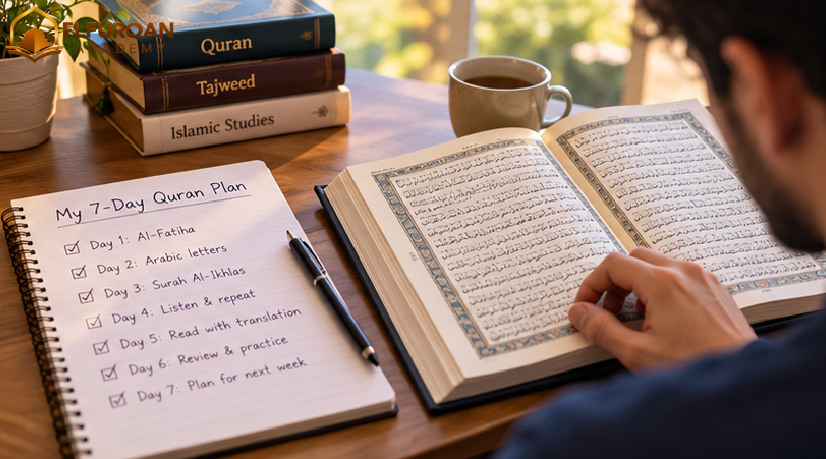
If you’re wondering how to begin, try this introductory routine.
| Day | Your Quran Activity |
| Day 1 | Read Surah Al-Fatihah slowly and explore its English meaning. |
| Day 2 | Practice Arabic letters and pronunciation for five minutes. |
| Day 3 | Read Surah Al-Ikhlas and reflect on its message. |
| Day 4 | Listen to a qualified Quran reciter and repeat a short passage. |
| Day 5 | Read a few verses and study their meanings in English. |
| Day 6 | Review previous verses and practice any difficult sounds. |
| Day 7 | Recite what you’ve learned and plan your next week. |
This seven-day schedule is a suggested educational plan, not a prescribed Islamic ritual.
Feel free to adjust it based on your experience, schedule, and reading ability.
What matters is making your routine sustainable.
Can You Read the Quran Daily Without Knowing Arabic?
Yes. You can begin learning to read the Quran even if you don’t know the Arabic alphabet yet.
Many English-speaking Muslims begin learning Quranic Arabic as adults.
Some are converts to Islam.
Others grew up in Muslim households but never received structured Arabic instruction.
And some simply want to reconnect with the Quran after years of limited practice.
Whatever your starting point, you can begin learning.
Start with the Arabic alphabet.
Learn how letters change shape when they connect.
Practice short vowels and basic pronunciation.
Then gradually move toward reading simple Quranic words and short surahs.
Use reliable English translations to understand the meanings while developing your Arabic reading ability.
If possible, study with a qualified teacher who understands the challenges faced by non-Arabic speakers.
Online Quran classes can be particularly helpful if you live in the United States, United Kingdom, Canada, or Australia and need lessons that fit around work, school, or family responsibilities.
With appropriate guidance, your reading practice can become more structured and productive.
Frequently Asked Questions
Explore answers to common questions about daily Quran reading, its spiritual benefits, and how beginners can build a lasting habit.
What are the benefits of reading Quran daily for beginners?
The benefits of reading the Quran daily for beginners include regular opportunities for remembrance of Allah, spiritual reflection, improved Arabic reading skills, stronger familiarity with Islamic teachings, and the development of consistent learning habits. Beginners can start with a few verses and gradually increase their practice as their abilities improve.
Is reading the Quran for five minutes a day enough?
Five minutes can be a meaningful starting point, particularly if you’re learning Arabic. Islam encourages consistent good deeds, even when they are small. As your recitation becomes easier, you can increase your reading time according to your circumstances.
What is the best time to read the Quran every day?
You can read the Quran at different times throughout the day. Many Muslims choose the morning, particularly after Fajr, because it can be a quiet time for worship and reflection. The best routine is one you can maintain consistently while observing the relevant etiquette of Quran recitation.
Can reading the Quran help you feel less stressed?
Quran reading can provide spiritual comfort, a sense of connection with Allah, and time for quiet reflection. However, experiences vary from person to person, and it should not be described as a guaranteed medical treatment for stress, anxiety, or depression.
Can I learn to read the Quran online?
Yes. Qualified online Quran teachers can help you study the Arabic alphabet, practice pronunciation, learn Tajweed, and develop your recitation skills. Look for teachers who provide structured lessons, individual feedback, and instruction appropriate for your current level.
Conclusion
Six months after that rainy Monday morning, Adam found himself sitting at the same kitchen table.
His phone was still buzzing.
His work schedule was still demanding.
And he still had difficult days.
But something had changed.
He could now recognize Arabic words that once seemed impossible to read.
He had memorized several short surahs.
He understood more of what he recited.
And whenever he opened the Quran, he no longer felt that he needed to be perfect before beginning.
He simply felt grateful that he had started.
His journey wasn’t about becoming fluent overnight.
It was about making room for Allah’s words in an ordinary, imperfect life.
And perhaps that’s one of the most beautiful benefits of reading Quran daily: discovering that meaningful spiritual growth can begin with small, sincere steps repeated over time.
If you’re struggling with Arabic pronunciation, don’t let that stop you.
If your schedule is busy, begin with a few minutes.
If you don’t understand a verse, seek its meaning and learn from a reliable source.
You don’t need to master the entire Quran before developing a relationship with it.
Open the Quran today. Read one verse. Reflect on its meaning. And continue your journey tomorrow.
Take the Next Step in Your Quran Learning Journey
Want to improve your Quran reading with guidance designed for non-Arabic speakers?
Explore our online Quran classes for beginners and learn Arabic pronunciation, Tajweed, and Quran recitation step by step with qualified teachers.
Your Quran journey can begin today.