
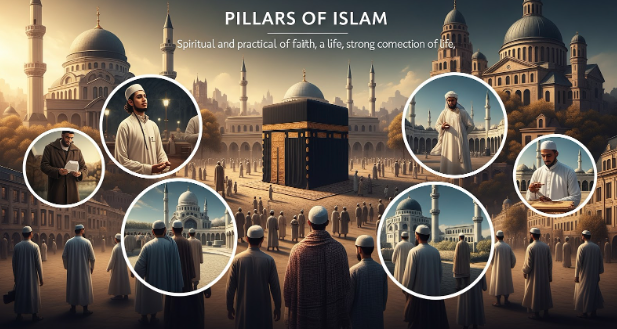
For Muslims around the world, the pillars of islam form the spiritual and practical foundation of faith. They are more than rituals — they represent a complete way of life, offering clarity, discipline, and connection to Allah. For Muslims living in Europe, where secular values often dominate public life, understanding and applying these pillars can feel both challenging and empowering.
This article explores the five pillars of islam with a focus on how Muslims in European societies can live by them confidently and meaningfully, while maintaining harmony with their environment.
What Are the Pillars of Islam?
The pillars of islam are five essential acts of worship that form the foundation of a Muslim’s faith and practice. In the following sections, we’ll explore each pillar and how to apply it.
1. Shahada – The Declaration of Faith
“La ilaha illallah, Muhammadur rasulullah.”
“There is no god but Allah, and Muhammad is the Messenger of Allah.”
The Shahada is the heart of Islam. It reflects a Muslim’s ultimate loyalty and devotion to Allah alone. In a society where individualism is often celebrated above spirituality, the Shahada keeps one grounded.
Tips for Muslims in Europe:
- Include reminders of the Shahada in your home décor, such as framed calligraphy.
- Use Islamic affirmations in your daily routine to strengthen your identity.
- Enroll in Online Quran Classes that focus on the foundations of belief to deepen your understanding of Tawheed and prophetic teachings.
2. Salah – The Five Daily Prayers
Prayer connects Muslims to their Creator throughout the day. The five daily prayers are not only moments of worship but also tools for managing stress, refocusing intentions, and staying mindful. For many, learning proper recitation—including mastering the rules of Tajweed—adds depth and beauty to the experience of prayer, transforming each verse into a meaningful act of devotion.
Challenges in Europe may include busy work schedules or a lack of prayer spaces, but they can be overcome.
Practical Tips:
- Set phone alarms with soothing Adhan tones.
- Politely request short breaks at work or university for prayer. In many European countries, employers are legally required to accommodate religious needs where possible.
- If learning proper recitation is a struggle, consider online tutoring with native Arabic teachers who offer flexible, one-on-one Quran and Salah classes tailored to your level and schedule.
3. Zakat – Charity and Social Responsibility
Zakat nurtures empathy and balances wealth. It’s not only a duty but a social system that uplifts the poor and purifies the giver.
Suggestions for fulfilling Zakat in Europe:
- Use trusted Islamic charity organizations that serve both local and global causes.
- Encourage your children to participate in charity drives to build compassion early.
- Platforms offering Islamic Studies often educate about the deeper meanings of Zakat and how to calculate and distribute it correctly in a modern context.
These resources can guide you in performing Zakat correctly, even if you are unsure about local rules or eligible recipients.
4. Sawm – Fasting in Ramadan
Fasting teaches restraint, spiritual focus, and solidarity with those in need. However, in some parts of Europe, fasting can last up to 20 hours in summer—requiring both physical and mental preparation. One of the most beautiful aspects of Ramadan is the frequent and soothing sound of the Qur’an being recited throughout the day and night, bringing peace and reflection to the heart.
Tips for a successful Ramadan in Europe:
- Plan suhoor and iftar meals in advance to conserve energy and time.
- Join local masjid programs or virtual Quran circles to stay spiritually connected during the month.
- Consider subscribing to structured online Ramadan programs that provide lessons, Qur’an recitation support, and spiritual reminders throughout the month.
These services are especially helpful for families or individuals who don’t have a nearby community.
5. Hajj – The Pilgrimage to Mecca
Hajj symbolizes ultimate submission to Allah and unity among Muslims. Although it’s a once-in-a-lifetime duty, the preparation starts much earlier.
If you’re living in Europe, consider:
- Attending pre-Hajj seminars at Islamic centers or joining online preparatory classes taught by experienced scholars.
- Saving monthly with intention and seeking advice from those who have completed the journey.
Even if you’re not able to go soon, some platforms now offer interactive Hajj simulations or virtual courses that teach the steps and spiritual meanings of Hajj engagingly—making the experience more relatable and accessible, especially for younger Muslims.
How to Teach Your Children the Pillars of Islam
For Muslim parents in Europe, raising children who understand and love their faith is a top priority. Teaching the pillars of Islam from an early age—through stories, visual aids, and interactive classes—helps form strong spiritual foundations. Many parents now rely on online tutors fluent in Arabic and English, who specialize in Quran and Islamic Studies for kids, making learning both fun and effective from home. That’s why more families are searching for the best ways to memorize the Qur’an for children—methods that are engaging, age-appropriate, and rooted in strong Islamic values.
Why the Pillars of Islam Matter Today?
In a world overwhelmed by material distractions and constant digital noise, the pillars of Islam serve as spiritual anchors that bring clarity, balance, and direction. They are not outdated rituals from a distant era—they are timeless principles that guide Muslims toward personal growth, inner peace, and a deeper connection with Allah. For those seeking to deepen their knowledge and commitment, enrolling in an ijazah course online can be a powerful step toward mastering the Qur’an and living by its teachings on a deeper level.
Here’s why the pillars of Islam continue to matter today:
- They preserve identity: Help Muslims remain spiritually grounded and connected to their faith despite external cultural pressures.
- They provide structure: Create daily, monthly, and yearly habits that promote discipline and purpose.
- They nurture empathy: Through acts like Zakat and fasting, they encourage care for others and awareness of social issues.
- They transcend geography: Whether in a Muslim-majority country or a secular European city, the pillars adapt and remain applicable.
- They strengthen family and community ties: Shared worship and learning help pass values to the next generation and build unity.
- They are more accessible than ever: With modern technology, learning and practicing the pillars—like prayer and Qur’an recitation—can be done from home, guided by qualified teachers online.
The pillars of islam are not just duties—they are lifelines. They give structure, peace, and divine connection in a world that can feel chaotic or spiritually empty.
For Muslims living in Europe, embracing the five pillars means embracing your identity with grace, strength, and wisdom. Don’t let the fast pace of modern life shake your foundation. Use the tools around you—your local community, your family, and trusted learning platforms—to keep your faith alive and vibrant.
Ready to strengthen your connection with the Quran and deepen your understanding of Islam? Book your free one-on-one trial session today and start learning with expert tutors wherever you are in the world.